CYou’ve got a great app idea. Maybe it’s been sitting in a note’s app for weeks. You’ve talked to a few developers, watched some YouTube videos, and now you’re more confused than when you started. Native? Cross-platform? Hybrid? And wait, aren’t cross-platform and hybrid about the same thing?
They’re not. And that confusion alone has led many businesses to make the wrong call and spend months rebuilding what they could have gotten right the first time.
This guide cuts through the confusion for Native vs hybrid vs cross-platform. By the end, you’ll know exactly what each approach means, where each one makes sense, and just as important, where each one falls apart. No vague “it depends” answers. Real and practically clear.
First, Let’s Settle the Biggest Confusion of Hybrid vs Cross App Development
Most blogs treat these two as the same. They’re not. Hybrid mobile app development (in the traditional sense) means building an app using web technologies such as HTML, CSS, JavaScript, and wrapping it inside a native shell. The app essentially runs as a web page inside a container. Tools like Apache Cordova and Ionic fall into this category.
Cross-platform development means writing code once, in a framework like Flutter or React Native and compiling it into actual native-like code that runs on both iOS and Android. It’s not a web page pretending to be an app. It talks to the device properly.
Here’s the thing, in 2026, when people say “hybrid,” they often mean cross-platform. The old-school hybrid approach (Cordova, WebView-based) is mostly used for legacy projects or very simple internal tools now.
Understanding Native vs Hybrid vs Cross-platform App Development Approach
Choosing between native, cross-platform, and hybrid app development is not just a technical decision; it directly impacts your app’s speed, scalability, user experience, and long-term maintenance costs. The right approach depends on what you are building, how fast you need to launch, and the level of performance your users expect. Let us have a detailed view of every approach.
Native App Development
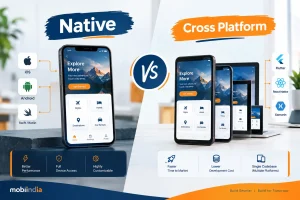
A native app is built specifically for one platform. iOS apps are written in Swift or Objective-C. Android apps are written in Kotlin or Java. There’s no sharing of code between the two, you build them separately.
Snapchat, Google Maps, and Instagram are real life examples of native app development. The original versions of these apps were built natively because performance and access to the camera, GPS, and hardware features were non-negotiable.
What you get with native:
- The best possible performance and no middleman between your code and the device
- Full access to every platform features the moment Apple or Google releases it
- Smoother animations, faster load times, and better battery efficiency
- Accessibility features work out of the box (screen readers, dynamic text sizing)
What you give up:
- Two separate codebases, one for iOS, one for Android
- Two separate teams (or a team that knows both Swift and Kotlin)
- Higher upfront cost and longer timelines, typically 12+ months for both platforms
- Every bug fix and feature update needs to be done twice
Key Features of Native App Development
Peak performance, zero compromise
Because native apps are written directly in the language, the platform understands, Swift for iOS, Kotlin for Android, there is no translation layer sitting between your code and the device. That means your app runs at full hardware speed, giving users the kind of fluid, responsive experience that makes them come back.
Day-one access to every platform feature
The moment Apple or Google ships a new API, whether that is a fresh camera mode, a new biometric system, or an OS-level feature, native developers can integrate it immediately. You are never waiting on a third-party framework to “catch up” before your app can take advantage of what the platform offers.
Smoother UI, faster loads, better battery life
Native rendering is handled directly by the platform’s own graphics engine, so animations are silky, transitions are sharp, and the app does not waste energy doing unnecessary computation in the background. Users may never consciously notice it, but they will notice when it is missing.
Accessibility that just works
Both iOS and Android have matured, deeply integrated accessibility systems, VoiceOver, Talkback, dynamic text sizing, and high-contrast modes. When you build native, these capabilities are baked in by default rather than something you must retrofit, which means your app is usable by more people from day one.
Cross-Platform App Development
Cross-platform app development lets you write one codebase and ship to both iOS and Android app development. Flutter (built by Google) and React Native (built by Meta) are the two dominant choices in this space today.
Flutter compiles directly to native ARM code. React Native uses a JavaScript bridge to communicate with native components. Both are miles ahead of the old Cordova-based hybrid apps.
Real-world examples of cross platform app development includes: Google Pay, eBay, Alibaba, and a huge chunk of startup apps you use daily are built on Flutter or React Native.
What you get:
- One codebase for both platforms, cuts development time by roughly 30–40%
- Faster time to market, typically 6 to 8 months vs 12+ for native
- Lower upfront costs
- One team handles both iOS and Android
- Bug fixes deploy to both platforms at once
What you give up:
- Performance sits around 80–90% of native, fine for most apps, limiting for a few
- New iOS/Android features sometimes take weeks or months to be supported in the framework
- Specialized hardware features (AR, Bluetooth low energy, advanced biometrics) can get complicated
- If your app needs 10+ native plugins, maintenance gets messy over time
Key Features of Cross Platform App Development
One codebase, two platforms
With cross-platform frameworks like Flutter or React Native, your engineering team writes the code once and ships it to both iOS and Android. That single shared codebase typically cuts development time by 30 to 40 percent, a meaningful advantage when speed and budget both matters.
Faster time to market
Where a full native build on both platforms typically takes 12 or more months, a well-executed cross-platform app can reach the App Store and Google Play in as little as six to eight months. For startups and product teams racing to validate an idea, that difference is often decisive.
Lower cost, leaner team
Because a single team manages the entire codebase, you avoid the overhead of maintaining parallel iOS and Android engineering streams. Bug fixes and new features deploy to both platforms at once, which means fewer release cycles, fewer coordination headaches, and a leaner overall budget.
Performance that is good enough
Cross-platform apps today run at roughly 80 to 90 percent of native performance; a gap most users simply will not feel in a typical app experience. Flutter compiles directly to ARM code, while React Native bridges to native components, and both are miles ahead of the old WebView-based approaches.
Hybrid App Development (Traditional / WebView-Based)
This is the “wrap a website in an app” approach, Ionic, Cordova, PhoneGap. The app opens a WebView and your web code runs inside it. In 2026, hybrid app development approach makes sense in very specific situations:
- Simple internal tools or employee portals
- Companion apps with limited functionality
- Prototypes or MVPs with a very tight budget
Be honest about its limits though. Frequent crashes, poor offline behavior, and slow load times are real problems that users will notice. If your app is consumer-facing and needs to compete in the App Store, this path will hurt you.
Native vs Hybrid App Development
The core difference between native vs hybrid app development comes down to one question: where does your code run? Native apps are built in the platform’s own language and execute directly on the device. Hybrid apps wrap web code inside a browser window and rely on that layer to communicate with the hardware beneath it.
Native gives you full speed, full access, and full control. Hybrid gives you speed to market and lowers upfront cost. The moment your app needs to do something, the WebView cannot cleanly handle, complex animations, real-time hardware access, offline reliability, native stops being the expensive option and starts being the only viable one.
Key Features of Hybrid Mobile App Development
Web stack wrapped as an app
Hybrid app development company works by loading your existing web code inside a WebView. Essentially a browser window packaged as a mobile application. If your team already knows HTML, CSS, and JavaScript, you can move directly into mobile development without learning Swift, Kotlin, Dart, or any other platform language.
The fastest path from idea to testable build
When the goal is to validate a concept quickly or ship something functional on a tight budget, hybrid development is hard to beat for raw speed. Internal employee portals, simple companion apps, and early-stage MVPs are exactly the kinds of projects where this approach delivers real value without overengineering the solution.
Real limitations users will notice
Frequent crashes, sluggish load times, and unreliable offline behavior are not edge cases with hybrid apps; they are common enough to define the experience. If your app is consumer-facing and competing in a crowded App Store category, those rough edges will show up in your reviews and in your churn rate.
At A Glance Comparison of Native vs Cross-Platform vs Hybrid
Here’s a clear side-by-side comparison of all three before we move further into the details. Save this for your next conversation with a mobile app developer or stakeholder.
| Factors | Native | Cross-Platform | Hybrid |
| Performance | Best (100%) | Very good (80–90%) | Moderate |
| Development Time | 12+ months | 6–8 months | 3–5 months |
| Cost (Year 1) | High | Medium | Low |
| Cost (Year 3) | Medium | Medium | Medium–High |
| UI Quality | Platform-perfect | Near native | Web-like |
| Device Feature Access | Full | Mostly full | Limited |
| Team Requirement | Two teams (or two skill sets) | One team | One team |
| App Store Approval | Smooth | Smooth | Can face issues |
| Best For | Complex, performance-critical apps | Most commercial apps | Simple internal tools |
One stat worth knowing over here is, apps that take more than 2 seconds to load see 33% higher uninstall rates. That’s where the performance gap between native and a poorly implemented hybrid app actually shows up in your business numbers.
Cost Comparison of Hybrid vs Native vs Cross Platform
Most cost comparisons stop in the first year. That’s where it gets misleading. Yes, a hybrid or cross-platform app costs less to build initially. But what happens when you need to scale? Add real-time AR filters? Integrate with complex device hardware? Handle 2 million users?
That’s when teams start rewriting things, and that’s when the “cost friendly” choice becomes the most expensive one.
The Airbnb story is the most famous example of this. In 2016, Airbnb adopted React Native for parts of their app. The early results were good, simple screens deployed fast, one team worked across both platforms. But as their product got more complex, the cracks showed up.
When Airbnb eventually sunsetted React Native, they noted that engineers who used it generally had a positive experience, and 74% would even consider it for a new project. The issue wasn’t the framework itself; it was that Airbnb’s specific product complexity and scale outgrew what cross-platform could cleanly handle at that time.
The lesson isn’t “cross-platform bad.” It’s that your choice today determines how flexible you have tomorrow. A startup building an MVP has completely different needs than a company serving 50 million users with AR features.
This is the point where it’s worth mapping out your 3-year product roadmap before making this call. Many teams skip this step and end up rebuilding 18 months in. If you’re unsure how to think through this, getting a second opinion from an experienced native app development team early can save a lot of reworks later. Here is an estimated cost comparison of the same.
| cost category | Native | Cross-platform | Hybrid |
| Initial build | $150k – $300k | $35k – $150k | $10k – $40k |
| Time to launch | 12+ months | 6 – 8 months | 3 – 5 months |
| Annual maintenance | 30 – 40% higher than cross-platform | 15 – 25% of build | 10 – 20% of build |
| Year 2 – 3 maintenances | $30k – $80k | $15k – $45k | $20k – $60kHidden costs emerge at scale |
| Rewrite / rebuild cost | Rarely needed | $40k – $120kIf scaling to native | $80k – $250k+Often a full rewrite |
| Scaling architecture upfront | +$8k – $15k | +$8k – $15k | Often not viable Framework ceiling |
| Developer team size | 2 separate teams iOS + Android specialists | 1 shared team30 – 40% fewer hours needed | 1 web team Existing skills reused |
| Estimated 3-year TCO | $210k – $420k | $65k – $240k | $90k – $340kIf a rewrite is triggered |
Which Industries Should Use Which Approach
This is the section most blogs skip entirely. The right choice among native vs cross platform vs hybrid app development isn’t just about your budget, it depends heavily on what kind of app you’re building and who’s going to use it.
| Industry | Recommended Approach | Why |
| Healthcare & Wellness | Native | HealthKit, Google Fit integration, biometrics, and strict compliance requirements demand deep platform access |
| Fintech & Banking | Native or Cross-Platform (Flutter) | Strong security, biometric authentication, encrypted transactions, and real-time financial data handling |
| Retail & eCommerce | Cross-Platform | Faster launch cycles, broader device reach, and support for standard commerce-focused features |
| EdTech & eLearning | Cross-Platform | Cost-efficient development with seamless access across Android and iOS devices |
| Gaming & AR/VR | Native | Direct GPU access, high frame-rate performance, and real-time rendering capabilities |
| Internal Enterprise Tools | Hybrid | Quick deployment, simplified workflows, and no dependency on App Store distribution |
| Startups / MVPs | Cross-Platform | Faster validation, rapid iteration, and lower initial development costs |
A healthcare app handling patient data and integrating with Apple Health? Go native, no question. A retail brand wanting to launch on iOS and Android in 5 months with a standard browsing-and-checkout experience? Cross-platform is the smarter call.
The Decision Framework for Your Business to Choose the Right Approach
As a trusted mobile app development company, we suggest the best approach as per your plan and product. Before locking in any approach, answer these honestly:
When do you need to launch? Under 6 months? Cross-platform or hybrid. 12+ months is acceptable? Natives become more viable.
What does your app actually need to do? Does it need AR, real-time video processing, or deep hardware access? Lean native. Does it need to push notifications, maps, payments, and user accounts? Cross-platform handles all of that without breaking a sweat.
Who’s your audience and how picky are they? If you’re competing with Snapchat or a high-end fintech app where users are used to a polished, pixel-perfect experience, native matters more. If your users just need a functional, reliable tool, cross-platform is fine.
What does your Year 3 look like? If you expect to add complex features, scale to millions of users, or go into AR/ML territory, build for that future now. Starting cross-platform and migrating pieces to native later is possible.
What’s your actual budget, not aspirational, but real? If you’re working with under $80,000 and need iOS app development and Android app development, cross-platform is almost always the right call.
At this stage, a lot of teams realize they need clarity on how these choices connect to their specific product vision. That’s exactly were working with an experienced hybrid app development company or cross-platform team helps, not to build the app for you yet, but to map the right architecture before the first line of code is written.
MobiIndia’s Suggestion Summary Before You Decide
Here’s the short version if you want to share this with someone on your team: Go native if performance is your core product, you’re in AR/gaming/healthcare, and you have the budget and timeline to support two separate codebases.
Go cross-platform and choose flutter app development or react native app development if you need to launch on both iOS and Android, you’re working with a reasonable budget, and your app features are in the mainstream range. This is the right call for probably 80–90% of businesses.
Go hybrid (WebView) only for internal tools, prototypes, or apps with very limited functionality and no competition from polished consumer apps. The cross-platform market is growing fast for good reason, frameworks have matured to the point where the old tradeoffs have shrunk significantly.
If you’re still working through the decision and want someone to look at your specific product requirements, our team at cross platform app development would be happy to help you map it out no pressure, just clarity on what fits your goals.
Find the Right Candidates in Less Time – Quickhire
Conclusion
The native vs hybrid vs cross-platform debate doesn’t have a universal winner. It has a right answer for your situation, and that answer changes depending on your budget, your audience, your features, and how ambitious your roadmap is.
What matters most is that you go in with your eyes open. Don’t choose cross-platform just because it sounds cost friendly. hoose a native just because it sounds premium. Don’t default to hybrid just because someone said it’s quick.
Match the approach to the product. And if you’re not sure, the smartest thing you can do is talk to someone who’s made this call dozens of times, before the architecture is set, and the clock is ticking.
Frequently Asked Questions
What is the difference between hybrid and cross-platform app development?
Traditional hybrid apps (Cordova, Ionic) run web code inside a native shell, essentially a website wrapped in an app. Cross-platform frameworks like Flutter and React Native actually compile to native-like code and interact directly with device components. Cross-platform apps perform significantly better and look more polished. In everyday usage, people often use “hybrid” loosely to mean cross-platform, but technically they’re different approaches.
Is hybrid app development still relevant in 2026?
Traditional WebView-based hybrid development is mostly used for internal enterprise tools, prototypes, or companion apps with limited functionality. For consumer-facing products competing in app stores, modern cross-platform frameworks (Flutter, React Native) have replaced the old hybrid approach. If someone is recommending Cordova or PhoneGap for a new public-facing app in 2026, ask why.
Which is more cost friendly than native or cross-platform app development?
Cross-platform is less costly upfront, usually by 30–40% on initial development costs because you’re building one codebase instead of two. However, “economically better” over three years depends on your app’s complexity. If your product stays within the mainstream feature set, cross-platform stays cost-effective for long-term. If you keep needing native-specific features added, costs converge. The key is to plan your roadmap before choosing.
Can cross-platform apps match native app performance?
For most apps, yes cross-platform performance sits around 80–90% of native speakers, and the average user won’t notice the gap. Where native still clearly wins real-time AR features, high-end gaming, heavy GPU rendering, and apps with very complex animations. For everything else, social apps, retail, fintech, edtech, productivity tools cross-platform perform well enough that users won’t have complaints.
When should a startup choose native over cross-platform?
A startup should lean toward native if their core product experience depends on hardware-level access (camera processing, AR, biometrics), if they’re in a regulated industry like healthcare with strict compliance needs, or if they’re building in a competitive space where UI quality is a direct business differentiator. Otherwise, for speed to market and budget efficiency, most early-stage startups are better served by cross-platform ship fast, learn from users, and invest in native features if and when the product demands it.