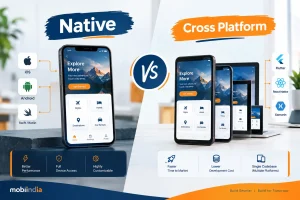
The mobile app market continues to grow rapidly, and businesses are under increasing pressure to launch apps. Whether you’re building a customer-facing application or an eCommerce platform, selecting the right development framework is one of the most important decisions you’ll make.
Among the many frameworks available today, Kotlin vs. React Native remains one of the most common comparisons. Both technologies have earned a strong reputation, but they are built for different purposes and offer distinct advantages. While Kotlin is known for delivering high-performance native Android applications, React Native enables mobile app development company to build apps for both Android and iOS using a single codebase, reducing development time and costs. Similarly, many organizations also compare Flutter vs. React Native before making a final decision, as both frameworks dominate the cross-platform development landscape.
In this guide, we’ll provide a detailed comparison of Kotlin and React Native, covering everything from performance and development speed to scalability, security, development costs, and business suitability.
Kotlin vs. React Native: Quick Decision Guide
If you’re short on time, here’s a quick recommendation to help you decide between Kotlin vs. React Native based on your business goals.
Choose Kotlin if you:
- You’re building an Android-only application.
- Your app requires maximum performance.
- You need deep Android hardware integration.
- You’re developing banking, healthcare, logistics, or enterprise applications.
- Security and long-term scalability are your top priorities.
Choose React Native if you:
- You want both Android and iOS apps from one codebase.
- You’re building an MVP or startup product.
- You have a limited development budget.
- Faster time-to-market is important.
- You want to reduce long-term maintenance costs.
What is Kotlin?
Kotlin is a modern, statically typed programming language developed by JetBrains and officially supported by Google for Android app development. Since becoming Google’s preferred language for Android in 2017, Kotlin has rapidly gained popularity among developers and businesses. Because of its concise syntax, improved safety features, and excellent interoperability with Java.
One of Kotlin’s biggest strengths is its way to create fully native Android applications. Kotlin is used in over 83% of top Android apps and commands a roughly 77% share of all store installations
Today, Kotlin has evolved beyond Android app development services through Kotlin Multiplatform, enabling businesses to share business logic. Across Android, iOS, desktop, and web applications while maintaining a native user interface for each platform. This approach helps reduce duplicate development efforts without compromising user experience.
Popular Apps Built with Kotlin
Several globally recognized brands use Kotlin to build or enhance their Android applications, demonstrating its ability to support millions of users while delivering excellent performance.
| Company | How Kotlin is Used |
| Improves Android development productivity and app stability. | |
| Trello | Uses Kotlin to simplify code maintenance and enhance performance. |
| Evernote | Migrated large parts of its Android application to Kotlin for cleaner and more maintainable code. |
| Uber | Uses Kotlin extensively for Android development to improve scalability and developer efficiency. |
| Netflix | Utilizes Kotlin for several Android components to deliver a smoother mobile experience. |
These real-world implementations highlight why Kotlin has become a trusted technology for building scalable, secure, and high-performance Android applications.
What is React Native?
React Native is an open-source mobile app development framework developed by Meta (formerly Facebook). It allows developers to build applications for both Android and iOS using a single JavaScript codebase, significantly reducing development time and effort.
Instead of creating two separate native applications, developers write one application that works across multiple platforms. React Native holds a 35% to 42% share of the global cross-platform mobile development market, placing it neck-and-neck with Google’s Flutter. React Native renders native UI components while sharing most of the application’s logic, offering a balance between development efficiency and native-like performance.
One of the primary reasons businesses choose React Native in Kotlin vs. React Native is its ability to accelerate product launches. Maintaining a single codebase, React Native development company can introduce new features, fix bugs, and release updates across both operating systems. React Native also benefits from a large open-source ecosystem, making it easier to integrate third-party libraries, APIs, and development tools. This flexibility enables businesses to create feature-rich applications without building every component from scratch.
Popular Apps Built with React Native
React Native powers some of the world’s most popular mobile applications, proving that cross-platform development can support large-scale products with millions of active users.
| Company | How React Native is Used |
| Shopify | Builds high-performance merchant experiences while maintaining a shared codebase. |
| Discord | Uses React Native to accelerate feature delivery across mobile platforms. |
| Implements React Native for selected features to improve development efficiency. | |
| Microsoft Office | Uses React Native in various mobile experiences to streamline cross-platform development. |
| Walmart | Adopted React Native to improve development speed and maintain consistent user experiences across Android and iOS. |
Kotlin vs. React Native: A Detailed Comparison
Understanding these differences helps organizations select the framework that best aligns with their technical and commercial goals.
| Feature | Kotlin | React Native |
| Development Type | Native Android | Cross-platform |
| Supported Platforms | Android | Android & iOS |
| Performance | Smooth | Depends |
| Development Speed | Medium | Fast |
| Code Reusability | Limited (Improved with Kotlin Multiplatform) | Up to 90% Shared Code |
| Development Cost | Higher | Lower |
| Time-to-Market | Moderate | Faster |
| Security | Excellent | Very Good |
| Community Support | Large | Massive |
| Best For | Enterprise Android Apps | Cross-Platform Apps, MVPs & Startups |
Performance
Performance is often one of the first factors businesses evaluate when comparing Kotlin vs. React Native. After all, application speed, responsiveness, and reliability directly influence user satisfaction and retention. Kotlin delivers true native performance because applications are compiled directly for Android. This allows the framework to fully utilize the device’s CPU, memory, GPU, and hardware features without relying on additional abstraction layers. Applications built with Kotlin generally offer faster startup times, smoother animations, lower latency, and better overall responsiveness, making it an excellent choice for performance-intensive applications such as mobile banking, healthcare, gaming, logistics, and enterprise solutions.
React Native also offers impressive performance for most business applications. Instead of rendering web views, it uses native UI components, allowing applications to deliver a near-native experience. However, because JavaScript communicates with native modules through a bridge (or the newer architecture in modern React Native), highly complex computations, graphics-heavy applications, or hardware-intensive features may require additional optimization or native modules.
Business Takeaway:
Choose Kotlin when performance is your top priority. Opt for React Native if you need strong performance while reducing development time and supporting multiple platforms.
Development Speed
Time-to-market has become a critical success factor for modern businesses. The faster you launch your product, the sooner you can validate ideas, attract users, and generate revenue.
This is where React Native has a significant advantage.
Since developers write a single codebase for both Android and iOS, much of the application’s functionality can be reused across platforms. Features only need to be developed once, reducing coding effort, simplifying testing, and accelerating deployment.
React Native also supports Hot Reloading, allowing developers to view changes instantly without recompiling the entire application. This significantly improves productivity and shortens development cycles.
Kotlin, on the other hand, focuses on native Android development. Although Kotlin itself increases developer productivity through concise syntax and reduced boilerplate code, businesses targeting both Android and iOS often require separate development efforts unless they adopt Kotlin Multiplatform.
As a result, native Kotlin projects generally take longer to complete compared to React Native applications, especially when both mobile platforms are involved.
Business Takeaway:
If your primary goal is to launch an MVP or commercial application quickly across Android and iOS, React Native provides a faster path to market.
User Experience (UI/UX)
A mobile application’s success isn’t determined by features alone. Users expect intuitive navigation, smooth interactions, attractive interfaces, and consistent performance across devices.
Kotlin excels in delivering a truly native Android user experience. Since applications are built specifically for Android, developers can fully utilize Material Design components, platform-specific animations, gestures, notifications, and accessibility features. This results in applications that feel highly responsive and integrate seamlessly with the Android ecosystem.
React Native also delivers a high-quality user experience by rendering native UI components instead of web elements. Most users cannot distinguish a well-built React Native application from a native app during everyday use. However, implementing highly customized animations or getting mobile UI/UX design services may require additional native development effort.
Business Takeaway:
For businesses that want the most authentic Android experience, Kotlin vs. React Native is an excellent choice. For organizations seeking a consistent cross-platform experience while minimizing development effort, React Native offers the ideal balance.
Scalability
Kotlin is highly scalable because it follows native Android architecture and integrates seamlessly with enterprise-grade backend systems. Large organizations often choose Kotlin for applications that require long-term stability, complex workflows, and extensive business logic.
React Native has also matured considerably and now powers large-scale applications used by millions of users worldwide. With proper architecture, you can scale effectively when you hire iPhone app developer for startups, mid-sized businesses, and even enterprise organizations.
The key difference lies in complexity. As applications become increasingly sophisticated, React Native projects may require more native modules and platform-specific customizations, whereas Kotlin naturally handles Android-specific scalability requirements.
Business Takeaway:
Both frameworks support business growth, but Kotlin is generally better suited for highly complex Android applications, while React Native provides excellent scalability for businesses targeting multiple platforms efficiently.
Security
Security is one of the most critical considerations when selecting a mobile app development framework, especially for businesses handling sensitive customer information, financial transactions, healthcare records, or confidential enterprise data. A secure application not only protects business assets but also helps maintain customer trust and comply with industry regulations.
When comparing Kotlin vs. React Native, Kotlin offers a slight advantage because it is a native Android programming language officially supported by Google. Developers can directly leverage Android’s built-in security features, including biometric authentication, encrypted storage, secure APIs, and platform-level security updates. Since there is no intermediary framework involved, businesses have greater control over application security and data protection.
React Native also supports robust security practices, but because it relies on JavaScript and third-party libraries, developers must carefully manage dependencies and implement secure coding practices. Fortunately, React Native offers various security libraries and native module integrations that help businesses build secure cross-platform applications.
Business Takeaway:
If your application operates in highly regulated industries such as banking, healthcare, or government, Kotlin provides stronger native security capabilities. For most commercial applications, React Native offers excellent security when implemented following industry best practices.
Development Cost
Budget is often one of the deciding factors for businesses choosing between React Native vs. Kotlin. The development framework directly influences project costs, resource requirements, maintenance efforts, and future scalability.
React Native is generally considered the more cost-effective option because developers can build Android and iOS applications using a single codebase. This significantly reduces development hours, testing efforts, maintenance costs, and future feature updates. Businesses launching startups, MVPs, or customer-facing applications often choose React Native to maximize ROI while minimizing initial investment.
| Project Type | React Native | Kotlin (Native Android) |
| Basic Mobile App | $15,000–$30,000 | $20,000–$40,000 |
| Medium Complexity App | $30,000–$70,000 | $40,000–$80,000 |
| Enterprise Mobile App | $70,000–$150,000+ | $90,000–$200,000+ |
| Android + iOS Development | Single Shared Codebase | Separate Development (Higher Cost) |
| Ongoing Maintenance | Lower | Moderate to Higher |
Kotlin, however, focuses on building native Android applications. If an organization also requires an iOS application, separate development is usually needed unless Kotlin Multiplatform is adopted. This naturally increases development costs, project timelines, and resource allocation.
Business Takeaway:
Businesses with limited budgets and aggressive launch timelines often benefit from React Native, while organizations prioritizing long-term Android performance may find Kotlin vs. React Native to be a worthwhile investment.
Time to Market
In today’s competitive digital landscape, launching a product quickly can provide a significant competitive advantage. Faster deployment enables businesses to validate ideas, gather customer feedback, and begin generating revenue sooner.
Kotlin vs. React Native is designed to accelerate development by allowing teams to build and maintain a single application for both Android and iOS. Developers can simultaneously release new features, fix bugs, and deploy updates across both platforms, reducing overall project timelines.
Kotlin offers excellent developer productivity for Android applications but requires separate development for iOS in many scenarios. This naturally extends project duration for businesses targeting both platforms.
For startups and businesses introducing new digital products, reducing time-to-market can be just as valuable as reducing development costs.
Business Takeaway:
If speed is a priority, React Native enables faster application launches. Kotlin is better suited for businesses that prioritize platform-specific optimization over development speed.
Code Reusability
Code reusability directly impacts development efficiency, maintenance costs, and long-term scalability. React Native’s greatest strength lies in its ability to reuse a large percentage of code across Android and iOS. Developers typically share around 80–90% of the application’s codebase, minimizing duplicate work and simplifying future updates.
Kotlin, in its traditional form, focuses primarily on Android app development. However, Kotlin Multiplatform vs. Flutter introduces partial code sharing by allowing developers to reuse business logic across platforms while maintaining native user interfaces.
This approach offers businesses the best of both worlds shared backend logic combined with platform-specific user experiences.
Business Takeaway:
For maximum code sharing across platforms, React Native vs. Kotlin remains the stronger option. Businesses seeking native interfaces with shared business logic should consider Kotlin Multiplatform.
Maintenance
Application development doesn’t end after deployment. Continuous maintenance is essential for fixing bugs, improving performance, introducing new features, and ensuring compatibility with operating system updates.
React Native simplifies maintenance because developers only manage a single codebase for multiple platforms. Feature updates, bug fixes, and performance improvements can often be implemented once and deployed across both Android and iOS simultaneously.
Kotlin applications generally require separate maintenance for Android. If businesses maintain independent Android and iOS applications, updates may require additional coordination and resources.
However, Kotlin applications often experience fewer platform-specific compatibility issues because they are built directly for Android using Google’s recommended development practices.
Business Takeaway:
React Native reduces ongoing maintenance efforts, while Kotlin vs. React Native offers greater platform stability for Android applications.
Community Support
A strong developer community contributes significantly to a framework’s long-term success. Active communities continuously develop libraries, share best practices, resolve technical challenges, and accelerate innovation.
React Native has one of the largest mobile development communities worldwide. Backed by Meta and supported by thousands of contributors, developers have access to extensive documentation, reusable libraries, plugins, tutorials, and community-driven solutions.
Kotlin also enjoys a rapidly growing community supported by JetBrains and Google. As Android’s preferred language, Kotlin benefits from official documentation, continuous updates, and increasing enterprise adoption.
Both frameworks have mature ecosystems, although React Native currently offers a broader range of third-party resources for cross-platform development.
Business Takeaway:
React Native provides a larger open-source ecosystem, while Kotlin offers strong official maintenance & support services and a rapidly expanding enterprise community.
Learning Curve
The ease of learning a framework affects hiring, onboarding, and overall development productivity.
React Native is built on JavaScript, one of the world’s most widely used programming languages. Businesses with existing web development teams can often transition into React Native development with minimal training, making hiring developers easier and reducing onboarding costs.
Kotlin introduces developers to modern programming concepts while maintaining interoperability with Java. Teams already experienced in Android or Java development typically adapt to Kotlin quickly.
For organizations starting from scratch, the learning curve depends largely on existing technical expertise and project requirements.
Business Takeaway:
Businesses with JavaScript expertise often adopt React Native more quickly, while Android-focused teams generally find Kotlin vs. React Native easier to master.
Kotlin vs. React Native: Which Framework is Better for Different Business Types?
Selecting the right framework depends on your business goals rather than simply choosing the most popular technology.
Startups
Startups typically prioritize speed, affordability, and rapid market validation. React Native enables businesses to launch Android and iOS applications simultaneously while keeping development costs under control.
Recommended: React Native
Small and Medium Businesses
Growing businesses need scalable applications without significantly increasing development expenses. React Native provides an excellent balance between cost efficiency and functionality.
Recommended: React Native
Enterprises
Large organizations often require enterprise app development services for, complex integrations, and high-performance applications. Kotlin delivers greater flexibility for building sophisticated Android solutions.
Recommended: Kotlin
Healthcare
Healthcare applications require secure patient data management, regulatory compliance, and reliable performance.
Recommended: Kotlin
Banking & Financial Services
Financial applications demand maximum security, low latency, and seamless performance.
Recommended: Kotlin
eCommerce
Retail businesses frequently require faster product launches, regular feature updates, and support across multiple devices.
Recommended: React Native
Logistics & Transportation
Logistics applications often rely on GPS tracking, offline functionality, barcode scanning, and real-time operations.
Recommended: Kotlin
On-Demand Service Apps
Food delivery, ride-sharing, home services, and booking applications benefit from React Native’s rapid development and cross-platform capabilities.
Recommended: React Native
Why Kotlin vs. React Native Is One of the Biggest Mobile App Development Decisions in 2026
The demand for mobile applications continues to grow as businesses invest in digital experiences, AI-powered services, and customer-first platforms. Whether you’re developing an eCommerce app, a healthcare platform, a fintech solution, or an enterprise application, selecting the right mobile app development framework directly impacts development cost, time-to-market, scalability, and long-term maintenance.
Today, Kotlin vs. React Native has become one of the most searched comparisons because both frameworks continue to evolve rapidly. While Kotlin remains Google’s preferred language for native Android app development, React Native has strengthened its position with the New Architecture, including Fabric and TurboModules, which improve performance and responsiveness.
At the same time, emerging technologies such as Kotlin Multiplatform, Jetpack Compose, AI-powered mobile applications, and cross-platform development strategies are influencing how businesses build modern mobile apps.
As a result, organizations are no longer asking “Which framework is popular?” Instead, they’re asking:
- Which framework delivers better performance?
- Which framework offers faster development?
- Which framework reduces mobile app development costs?
- Which framework is more future-ready?
- Which framework provides better ROI?
This Kotlin vs. React Native comparison answers these questions by evaluating performance, development speed, scalability, security, cost, developer experience, AI readiness, and long-term business value.
Factors to Consider Before Choosing a Mobile App Framework
Here are some key factors every business should consider before deciding.
Define Your Business Goals
Every successful mobile application begins with a clear objective. Some businesses want to launch an MVP quickly to validate a new idea, while others need a feature-rich enterprise application capable of supporting millions of users. Understanding your business goals helps determine whether you need the speed and affordability of React Native or the native performance offered by Kotlin.
Consider Your Budget
Budget plays a major role in selecting a development framework. Cross-platform frameworks like React Native generally reduce development costs because a single codebase supports both Android and iOS.
Native development with Kotlin may require a larger investment, especially if an iOS application also needs to be developed separately. However, hire Android developer for superior Android performance often view this investment as worthwhile.
Evaluate Your Time-to-Market
Launching an application quickly can provide a significant competitive advantage. If speed is a priority, React Native enables businesses to release Android and iOS applications simultaneously, shortening development cycles and accelerating product launches.
Organizations building mission-critical enterprise solutions may prioritize long-term quality over immediate deployment speed.
Think About Future Scalability
Your mobile application should be capable of growing alongside your business. As customer numbers increase and new features are introduced, the underlying architecture should continue performing efficiently.
Both Kotlin vs. React Native support scalability, but the right choice depends on application complexity and future expansion plans.
Identify Your Target Audience
Knowing where your users are located and which devices they use can influence your technology decision.
If your customer base is primarily Android users, Kotlin may provide the best experience. If both Android and iOS users represent a significant portion of your audience, React Native offers broader reach while reducing development effort.
Review Your Existing Technology Stack
Organizations often benefit from selecting technologies that align with their existing technical expertise.
Companies with experienced JavaScript developers can adopt React Native more easily, while businesses with Android or Java teams may achieve greater productivity using Kotlin.
Leveraging existing skills reduces onboarding costs and accelerates development.
Plan for Long-Term Maintenance
Application development doesn’t stop after launch. Regular updates, security patches, operating system upgrades, and feature enhancements require continuous maintenance.
Businesses should consider not only initial development costs but also the long-term effort required to maintain and scale their application.
Prioritize Security and Compliance
Applications handling financial transactions, healthcare information, or confidential enterprise data require strong security practices.
Although both frameworks support secure development, businesses operating in regulated industries should carefully evaluate compliance requirements before selecting a technology.
Conclusion
There is no one-size-fits-all answer in the Kotlin vs. React Native debate because the right framework depends entirely on your business objectives, technical requirements, budget, and long-term vision.
If your priority is building a high-performance Android application with maximum security, native functionality, and seamless platform integration, Kotlin is an excellent choice. It is particularly well-suited for enterprise applications, banking solutions, healthcare platforms, and other performance-intensive projects.
On the other hand, if your goal is to launch Android and iOS applications quickly while optimizing development costs, React Native provides an efficient and scalable solution.
Frequently Asked Questions
1. Which is better: Kotlin vs. React Native?
Neither framework is universally better. Kotlin is ideal for high-performance native Android applications, while React Native is better suited for businesses looking to develop Android and iOS apps using a single codebase with faster time-to-market.
2. Is React Native faster than Kotlin?
React Native generally enables faster development because developers maintain one codebase for multiple platforms. However, Kotlin applications usually deliver better runtime performance since they are built natively for Android.
3. What is the difference between React Native and Kotlin Multiplatform?
React Native shares both the user interface and business logic across platforms. Kotlin Multiplatform shares business logic while allowing developers to build native user interfaces for Android and iOS separately.
4. Which framework is more cost-effective?
React Native is usually more cost-effective for cross-platform projects because it reduces development and maintenance efforts through a shared codebase. Kotlin may require a higher investment but offers superior native performance.
5. Can React Native be used for enterprise mobile applications?
Yes. React Native is widely used for enterprise applications and supports features such as secure authentication, API integrations, cloud connectivity, offline functionality, and scalable architecture when implemented correctly.
6. Does Google recommend Kotlin?
Yes. Google officially recommends Kotlin as the preferred language for Android app development. It offers modern syntax, improved safety features, seamless Java interoperability, and full support for Android Jetpack libraries, making it the first choice for building native Android applications.
7. Is React Native dead?
No, React Native is far from dead. It remains one of the most popular cross-platform frameworks, supported by Meta and used by companies like Shopify, Microsoft, and Discord. It continues to receive regular updates and is widely adopted for building iOS and Android apps from a single codebase.
8. Is Kotlin Multiplatform replacing React Native?
Not entirely. Kotlin Multiplatform and React Native serve different purposes. Kotlin Multiplatform focuses on sharing business logic while allowing native UI development, whereas React Native enables developers to build cross-platform apps using a shared JavaScript codebase. The right choice depends on your project goals.
9. Which framework is future-proof?
There isn’t a single future-proof framework for every project. React Native is ideal for rapid cross-platform development, while Kotlin is a strong choice for high-performance Android applications and Kotlin Multiplatform projects. The best option depends on your business requirements, scalability goals, and development strategy.
10. Is React Native suitable for enterprise applications?
Yes. React Native is widely used for enterprise mobile applications because it enables faster development, code reusability, and easier maintenance across Android and iOS. With proper architecture, security, and performance optimization, it can successfully support large-scale enterprise solutions.
11. Is Kotlin a good choice for startups?
Yes. Kotlin is an excellent option for startups building Android-first products. It provides native performance, strong security, concise code, and long-term maintainability. If your initial target audience primarily uses Android devices, Kotlin can deliver a robust and scalable foundation for future growth.