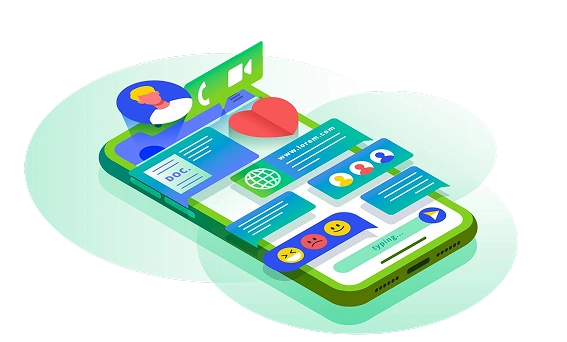
Our wearable app development company builds sensor-aware, platform-optimized applications for smartwatches, fitness bands, AR/VR headsets, and IoT-connected devices, built to perform outside a demo environment.

Our wearable app development services in India power products for companies in healthcare, fitness, enterprise, and consumer tech.


Wearables are not smaller smartphones. They carry strict constraints around battery life, screen real estate, background processing, and sensor accuracy. Getting those wrong in the architecture phase means expensive fixes later, or worse, a product users stop wearing.
Our wearable devices app development company has delivered products across healthcare, fitness, logistics, and enterprises for over a decade. The products we ship handle real-world sensor variability, stay power-efficient, sync reliably, and keep working when the phone is not nearby.
Our Internet of Things experience feeds directly into how we approach connected wearable ecosystems, the device is just one layer in a larger data loop.
Our mobile app development company covers every type of wearable category, from consumer fitness bands to enterprise AR headsets, with development grounded in device-specific constraints, not generic mobile logic.

We build wearable apps where AI does the heavy work, detecting patterns in continuous sensor data, adapting to individual users, and surfacing insights at the right moment without draining the battery. Every AI app development decision is made with the device's processing constraints in mind, not retrofitted from a cloud-first model.

We develop native apps for Wear OS devices with full command of the Wear OS SDK, Tiles, Complications, and background task handling. Android app development for wearables requires handling BLE pairing, sensor permissions, and power management in ways standard Android builds never address, we cover all of it from day one.

We build watchOS apps using SwiftUI and ClockKit that feel native to Apple Watch, not shrunken phone UIs. Our iOS app development team handles complication data sources, independent watch operation, HealthKit access, and the strict background execution rules that Apple enforces. The experience is tight and reliable across every Apple Watch generation.

We develop immersive apps for AR and VR headsets used in training, remote assistance, industrial inspection, and retail visualization. These apps combine real-time spatial data, gesture input, and visual overlays that need to stay accurate under movement. We use ARKit, ARCore, and OpenXR depending on the device and use case.

We build fitness tracking apps that pull from the full sensor stack, heart rate, SpO2, GPS, accelerometer, sleep data and deliver a clear, motivating user experience on a small screen. Our fitness app development work covers both consumer wellness products and clinical-grade activity monitoring systems where accuracy and audit trails matter.

Not every wearable app is about health. We build utility apps that give workers, field teams, and consumers fast, hands-free access to information and controls without picking up a phone. Whether it is checklist management, QR scanning, push-to-talk, or payment confirmation, we design these apps around the scenarios that were reaching for a phone is a problem.

Smart bands sit in their own device category, smaller screens, simpler interactions, and longer battery cycles. We build apps specifically tuned for band hardware from brands like Fitbit, Xiaomi, and Samsung Galaxy Fit. The focus is on accurate data collection, efficient BLE sync, and a companion phone app that makes the band's data genuinely useful rather than just decorative.

We develop hands-free enterprise applications for Google Glass and similar heads-up display devices used in warehousing, surgery, and field service. These apps deliver the right information in the worker's line of sight without breaking their workflow. The challenge here is UI design for a screen the size of a postage stamp, and we have solved it across multiple production deployments.

We connect wearable devices into wider IoT ecosystems, smart buildings, industrial environments, healthcare facilities, and supply chain networks. Our IoT developmentexperience means we understand how to manage device registration, real-time telemetry, edge processing, and secure cloud pipelines at scale, not just how to read a sensor.

MobiIndia's wearable app development services in India spans healthcare, enterprise, and consumer sectors. Here are three builds with results that went beyond the project brief.


Every tool in our stack is chosen for battery efficiency, cross-platform wearable behavior, and the ability to handle continuous sensor data without compromise.




Wearable apps are not a nice-to-have feature. For the right use cases, they change how quickly decisions get made and how closely a product stays connected to the person using it.

A wearable captures health, location, and activity data passively. The user does not have to open an app or remember to log anything, the product stays useful even when the user is not actively thinking about it.

For warehouse workers, nurses, and field technicians, a wrist-based app eliminates the phone entirely. Information is visible; confirmations are one tap, and hands stay free for the actual job with wearable app development services in India.

Wearables monitoring vitals or environmental conditions can detect problems before they become emergencies, whether that is an irregular heartbeat in a patient or a fall detected in a lone worker.

A product people wear daily has far more daily active touchpoints than any phone app. If the app adds real value to that wearing experience, the habit loop is much stronger and churn is significantly lower.

Wearable data aggregated at the fleet or workforce level tells you things about traditional reporting misses, movement patterns, response times, physical strain, and environmental exposure across your team in real time.

Unlike apps that behave the same on day one as day three hundred, a wearable app with an AI layer learns individual patterns and improves its usefulness the longer someone wears it. That compounding value is difficult for competitors to replicate quickly.
Wearable development has more variables than standard mobile work platform restrictions, hardware compatibility, sensor behavior, and cloud sync all need to be planned upfront. Here is how our mobile developers keep delivery predictable.
We map the target device, user environment, sensor requirements, platform restrictions, and business outcomes before a single line of code is discussed.
We define the data flow between device, phone, and cloud sensor collection logic, sync intervals, background task handling, and where AI inference happens on-device versus server-side.
Our UI/UX team designs specifically for wearable screen constraints. We prototype core interactions on actual hardware to validate what is readable and usable.
We build in two-week sprints with a working build at each milestone. Wearable integration testing runs in parallel with mobile development from the first sprint, not as a final step.
We test physical hardware across device generations, sensor accuracy, battery behavior over multi-day cycles, BLE sync reliability, and background mode compliance.
We deploy to your cloud environment, handle App Store and Play Store submissions, provide full source code and device configuration documentation.
Different wearable projects have different scopes, timelines, and team requirements. Here is how you can work with us depending on where you are in the development phase.
As the best wearable app development company, we have built wearable apps for industries where connected, body-worn technology is central to operations, safety, or user experience and not a peripheral feature.



Most wearable projects run over schedule or underperform because the development team applied phone-first thinking to device-first problems. Here is what makes our approach different in practice.


We do not support watchOS and Wear OS the same way. We understand the real behavioral differences between how each platform handles background modes, sensor sampling, and BLE connectivity, and we account for them in the architecture from week one, not as post-launch patches.

Battery life is the metric most wearable app that fails silently. We make active choices about sensor polling frequency, sync batching, and on-device processing boundaries at the design stage. Users keep wearing a device when it lasts until the day.

Wearable behavior in a simulator diverges physical devices in ways that matter, sensor timing, haptic feedback, screen brightness thresholds. We test actual hardware across device generations throughout development, before launching.

We build the wearable app, the companion mobile app, the cloud backend, and any dashboard or analytics layer. You coordinate with one team across the entire system rather than managing a wearable agency, a cloud vendor, and a mobile studio separately.

Wearables collect intimate data, biometrics, location, and sleep patterns. We build HIPAA-aligned and GDPR-compliant data handling into every health-related project from the architecture phase. Consent flows, anonymized analytics, and data retention policies are standard, not optional additions.
We are a software development company. If a project requires custom firmware development, hardware certification, or PCB design, we say so clearly and connect you with the right specialist. You will always have an accurate picture of exactly what our engagement covers before signing anything.
Cost depends on the device category, whether you need iOS, Android, or both, how complex the sensor integration is, and whether you need a cloud backend and dashboard. A focused single-platform MVP typically runs between $15,000 and $45,000. Multi-platform builds with health data pipelines, AI features, and enterprise integrations range from $60,000 to $150,000.
A well-scoped single-platform MVP takes 10 to 16 weeks. A full build covering multiple device categories, a companion mobile app, cloud backend, and analytics dashboard typically take 18 to 30 weeks. Timeline is directly tied to how clearly the device's scope and user flows are defined at the start, which is why we invest heavily in discovery before any code begins.
Yes. We frequently extend existing iOS and Android apps with wearable companion features — watch faces, quick-glance complications, health data sync, and notification management. This is often faster than building a standalone wearable app and keeps your existing user base in one product ecosystem.
We build explicit user consent flows, use anonymized identifiers for behavioral analytics, and implement clear data retention policies as standard on every project. For healthcare applications, we align with HIPAA requirements throughout the build, not as a compliance review at the end.
Yes, and we treat them as distinct platforms rather than interchangeable targets. The background execution rules, sensor sampling behavior, UI component libraries, and BLE handling differ meaningfully between the two. We account for these differences in the mobile architecture from the start, so the experience is consistent and reliable on both platforms.
Every project includes a 30-day post-launch support period at no extra cost. Beyond that, we offer a monthly maintenance retainer covering OS and SDK compatibility updates, hardware firmware changes, cloud infrastructure monitoring, and iterative feature additions as your device network grows.

Get a Free Consultation, Cost Estimate & Development Roadmap from Mobile App Experts Within 60 Minutes.

“Mobindia transformed our idea into a powerful mobile app that our users love. Their strategy, design and development expertise helped us launch faster.”
Sarah Williams
“The Mobindia team exceeded our expectations. Their communication, design process and technical expertise helped us launch a scalable mobile application.”
Michael Johnson+91 9876543210
sales@mobindia.com
Mobindia, 607 Tower A, Gurgaon, India
Discuss your app idea, business goals, challenges and requirements.
Rated 4.9/5 by 1000+ Global Clients
15+ Years of Mobile App Development Experience