The mobile app development market is expanding at a rapid pace. Nowadays, users are constantly looking for entertainment, wellness, and inspiring apps. And this demand for feature-rich mobile apps has grown over the last decade. The global mobile application market size is projected to reach USD 626.39 billion by 2030, growing at a CAGR of 14.3%. And this surge indicates the continuation of user demands. However, that raises a question for entrepreneurs to choose the types, budget, and tech stack to define objectives. And if you want to know how to keep it all aligned, let’s explore this go-to guide for your queries.
Why Is Mobile App Development Booming in 2026?
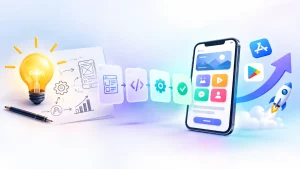
At its core, mobile app development is the process of designing and building apps that run on mobile devices. The typical mobile app development process flowchart includes different stages. Such as ideation, strategy, UI/UX design, development, testing, launch, and upgrades. In-app purchase revenue is expected to soar to nearly USD 450 billion by 2030, with gaming, entertainment, and health apps dominating.
It simply means creating a way for users to access a business service via their smartphones. Mobile apps transform business functionality into accessible mobile experiences.
What Are the Main Types of Mobile App Development?
Here are the major types of mobile applications.
Native Apps
Native applications are built specifically for a single operating system. That means an app developed for Android will not run on iOS unless it is built for that platform. These apps are designed to work seamlessly within the ecosystem they are created for.
Web Apps
Web apps function through a mobile browser. They are essentially responsive websites that adapt to different screen sizes and devices. Unlike native apps, users do not need to download them from an app store.
Hybrid Apps
Hybrid apps combine elements of both native and web applications. They are built using web technologies but packaged within a native container to be distributed via app stores. This approach offers a balance between performance and development efficiency.
Progressive Web Apps (PWAs)
Progressive Web Apps bridge the gap between traditional web apps and native applications. They run in a browser but offer advanced features like offline functionality and push notifications. Users can install them directly from the browser without visiting an app store.
Additional Ways to Classify Mobile Apps
Beyond the technology used to build them, mobile apps are also grouped by purpose and target audience.
Social Networking Apps
Platforms such as Facebook and TikTok focus on user interaction, content sharing, and community engagement. They typically include feeds, messaging, and live content features.
Entertainment Apps
Streaming services like Netflix and YouTube deliver video and multimedia content. It often enhances with personalized recommendations.
Utility Apps
These apps serve practical everyday purposes such as calculations, reminders, or note-taking. They are usually lightweight and designed for quick access.
Gaming Apps
Games range from casual puzzles to advanced multiplayer experiences. Titles like Candy Crush Saga and PUBG Mobile demonstrate how mobile gaming can be both casual and immersive.
E-Commerce Apps
These apps facilitate online shopping, secure checkout, order tracking, and personalized suggestions.
Health and Fitness Apps
Designed to monitor physical activity, nutrition, and overall wellness. These apps often integrate with wearable devices.
Education and E-Learning Apps
Learning platforms provide courses, tutorials, quizzes, and progress tracking to support skill development.
Finance Apps
Banking and budgeting apps allow users to manage accounts, track expenses, and monitor investments.
Travel Apps
These apps assist with bookings, navigation, itinerary planning, and real-time travel updates.
Business and Productivity Apps
Work-focused apps streamline collaboration, document sharing, and project management for firms.
End-to-End Mobile App Development Process Flow
Here are the complete mobile app development process steps.
Ideation and Validation
Every successful application begins with a clear, user-focused idea. Contrary to belief, complexity doesn’t guarantee success. Simplicity and clarity often drive adoption. Sit down with the team to discuss the initial requirements to start the business app development.
Strategy and Planning
This stage aligns business objectives with technical feasibility. Market research, competitor analysis, and feature prioritization shape the roadmap. You know the strategy to work as per the defined plan to achieve business objectives.
UI/UX Design and Wireframing
User research and wireframing form the foundation of effective business mobile application development. Wireframes visualize the structure and user’s journey before coding begins. Skipping this stage often leads to expensive redesigns.
Development and Framework Selection
Selecting the right mobile app development framework determines scalability, maintainability, and long-term performance. Clean coding practices and modular architecture reduce technical debt and ensure sustainable growth.
Testing and Beta Launch
Testing is a critical stage in the mobile app development process flowchart. Functional testing, performance testing, and security assessments ensure reliability. Beta releases allow real-world feedback before full deployment.
Launch and Ongoing Support
Contrary to common belief, mobile app development does not end at launch. Regular updates, performance monitoring, and feature upgrades help to meet expectations. Get the right partner to offer post-maintenance and support.
How to Choose the Right Mobile App Development Company?
Here are the key considerations to select the best partner.
Define Your Requirements First
Before approaching any development company, it is crucial to understand your objectives. Identify the problem your app aims to solve, define your target audience, and determine the platform. And if you want to prioritize iOS, Android, or both.
Evaluate Experience and Expertise
Experience matters significantly in mobile app development. A mobile app development company with a proven track record helps to anticipate challenges and provide stable solutions.
Review their portfolio to see whether they have handled projects similar to yours. Industry-specific experience can be valuable, as it shows familiarity with domain regulations. Additionally, assess whether the company stays updated with modern technologies.
Analyze Client Feedback
Client reviews and testimonials provide insight into company operations. Third-party review platforms often offer unbiased perspectives on professionalism and delivery standards.
Long-term client relationships indicate reliability and trustworthiness. If businesses repeatedly collaborate with the same partner, it is a strong indicator of satisfaction.
Review Budget Pricing
Cost should be evaluated realistically. While staying within budget is important, choosing the lowest bid can lead to compromised quality.
Hire mobile app developers who help in design, development, testing, and post-launch support. Ensure that maintenance and update costs are clearly outlined, as mobile apps need continuous improvements.
Post-Launch Support and Maintenance
Launching the app is only the beginning. Bugs, system updates, and evolving user expectations require ongoing technical support.
Choose a company that offers structured maintenance plans and responsive technical assistance. Quick resolution of performance issues helps maintain user satisfaction and protects brand credibility.
How Much Does Mobile App Development Cost in 2026?
Here is the complete step-by-step cost breakdown of mobile apps.
| Development Stage | What It Includes | Estimated Cost Range (USD) |
| Discovery Phase | Market research, competitor analysis, feature planning, roadmap creation, KPI definition | $5,000 – $15,000 |
| UI/UX Design | Wireframes, user journeys, prototypes, visual design, interactive elements | $5,000 – $25,000 |
| Core Development (MVP Level) | Frontend & backend development, APIs, database setup, basic integrations | $30,000 – $80,000 |
| Core Development (Advanced / Enterprise) | Custom architecture, AI features, payment systems, third-party integrations, scalability setup | $80,000 – $200,000+ |
| Testing & QA | Device testing, performance optimization, bug fixing, security checks | $5,000 – $20,000 |
| First-Year Maintenance | Updates, feature enhancements, server costs, security patches | 15% – 40% of total development cost |
Related Blog – React Native Mobile App Cost
Total Estimated Cost Overview
- Basic App (MVP): $50,000 – $100,000
- Mid-Level App: $100,000 – $180,000
- Enterprise-Grade App: $200,000 – $500,000+
The Discovery Phase
Every successful app begins with research and strategic planning. The discovery stage defines objectives, studies competitors, and outlines technical requirements.
This phase includes market research, features, timeline, KPI identification, and product roadmap creation. Complex apps require deeper analysis, which increases time and cost. Businesses must also decide whether to build in-house or outsource development.
UI/UX Design
Design shapes first impressions. A well-designed interface ensures users immediately understand how to navigate the app. Mobile app development Costs in this stage depend on complexity. Basic layouts require less time than custom animations or advanced interactive designs. On average, app design investments range widely based on scope and sophistication.
Core Development
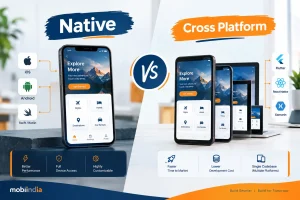
This stage consumes the largest portion of the budget. It includes frontend coding, backend architecture, API integration, database management, and third-party services. Choosing between native and cross-platform development significantly affects costs. Native apps require separate builds for iOS and Android, increasing time and expense. Cross-platform solutions reduce duplication but may limit certain performance optimizations.
Testing and Ongoing Maintenance
Testing ensures the app functions smoothly across devices and operating systems. After launch, maintenance becomes continuous. Updates, bug fixes, security patches, and feature improvements require ongoing investment.
Top Mobile Development Companies in India
Here are some of the best business mobile app development companies to choose from.
MobiIndia
Website: https://www.mobiindia.in/
Headquarters: Gurgaon, India
Overview:
MobiIndia is a mobile app development company delivering end-to-end mobility solutions for startups, SMEs, and enterprises. The company focuses on creating scalable, performance-driven mobile applications tailored to diverse industry requirements.
Major Services:
- Native iOS & Android app development
- Cross-platform app development
- Enterprise mobility solutions
- Notable Clients: NDTV, PepsiCo, Hero
USPs:
- Agile development methodology
- Industry-focused mobility expertise
- Strong UI/UX-driven development approach
Orangemantra
Website: https://www.orangemantra.com/
Headquarters: Gurgaon, India
Overview:
Orangemantra is a digital transformation and mobile app development company helping enterprises modernize their digital ecosystems. The company combines mobility solutions with AI, IoT, and cloud technologies to build scalable mobile platforms.
Major Services:
- Enterprise mobility
- Cloud application development
- Digital transformation consulting
- Notable Clients: Hero, PVR, Honda
USPs:
- Enterprise-grade mobile solutions
- Strong digital transformation expertise
- Multi-technology integration capabilities
Infosys
Website: https://www.infosys.com/
Headquarters: Bangalore, India
Overview:
Infosys is a global IT services leader offering enterprise mobility solutions as part of its digital services portfolio. The company delivers large-scale mobile transformation initiatives, combining analytics, cloud, and AI to build secure and scalable mobile ecosystems for global enterprises.
Major Services:
- Enterprise mobile application development
- Cloud & AI integration
- Digital transformation services
- Notable Clients: Global Fortune 500 enterprises
USPs:
- Global delivery model
- Enterprise-level scalability
- Strong governance & compliance frameworks
Wipro
Website: https://www.wipro.com/
Headquarters: Bangalore, India
Overview:
Wipro offers advanced mobile development services that are integrated with AI, cloud, and cybersecurity capabilities. The company supports enterprises in building secure, high-performance mobile applications that align with broader digital transformation strategies.
Major Services:
- Mobile application development
- Cloud-enabled mobility
- Cybersecurity solutions
- Notable Clients: Global enterprise clients across industries
USPs:
- Strong focus on security & compliance
- Integrated AI and cloud capabilities
- Enterprise mobility leadership
TCS
Website: https://www.tcs.com/
Headquarters: Mumbai, India
Overview:
Tata Consultancy Services (TCS) delivers enterprise-grade mobile application solutions globally. The company focuses on innovation-driven mobility, integrating analytics, automation, and cloud infrastructure to enable large-scale digital ecosystems.
Major Services:
- Enterprise mobile app development
- Cloud & automation services
- Application lifecycle management
- Notable Clients: Global Fortune 500 companies
USPs:
- Global IT leadership
- Large-scale project execution capability
- Strong R&D and innovation framework
TechAhead
Website: https://www.techaheadcorp.com/
Headquarters: Noida, India
Overview:
TechAhead is a product engineering and mobile app development company specializing in building user-centric and scalable mobile applications. The company works closely with startups and enterprises to design innovative digital products that drive engagement and growth.
Major Services:
- iOS & Android development
- Cross-platform app development
- AI-powered mobile apps
- Notable Clients: Audi, AXA, American Express
USPs:
- Product-focused development approach
- Strong design & innovation capabilities
- Experience with global brands
Softura
Website: https://www.softura.com/
Headquarters: Chennai, India
Overview:
Softura delivers enterprise mobility and custom mobile application development services across industries. The company emphasizes scalable architecture, cloud integration, and user-focused mobile experiences that align with business objectives.
Major Services:
- Mobile app development
- Enterprise software development
- Application support & maintenance
- Notable Clients: Enterprise clients across manufacturing & retail sectors
USPs:
- Custom enterprise solutions
- Cloud-integrated mobility services
- Long-term technology partnerships
Hidden Brains
Website: https://www.hiddenbrains.com/
Headquarters: Ahmedabad, India
Overview:
Hidden Brains is a digital solutions provider offering comprehensive mobile app development services. The company specializes in delivering innovative, scalable, and cost-effective mobility solutions tailored to startups and mid-sized enterprises.
Major Services:
- Custom mobile app development
- Hybrid app development
- Web & enterprise solutions
- Notable Clients: Sony, Johnson & Johnson
USPs:
- Cost-effective development models
- Startup-friendly engagement approach
- Strong cross-platform expertise
MindInventory
Website: https://www.mindinventory.com/
Headquarters: Ahmedabad, India
Overview:
MindInventory is a mobile app development company known for delivering intuitive, performance-oriented applications. The company focuses on emerging technologies, including AI, AR/VR, and IoT, to create advanced mobile experiences for global clients.
Major Services:
- iOS & Android app development
- Cross-platform development
- App maintenance & support
- Notable Clients: Panasonic, KFC
USPs:
- Emerging technology expertise
- Design-driven development
- Flexible engagement models
ValueCoders
Website: https://www.valuecoders.com/
Headquarters: Gurugram, India
Overview:
ValueCoders is an IT outsourcing company offering mobile application development services for startups, SMEs, and enterprises worldwide. The company focuses on cost-effective, scalable, and secure mobile solutions supported by dedicated development teams.
Major Services:
- Dedicated mobile app developers
- Native & hybrid app development
- SaaS application development
- Notable Clients: Dubai Police, Thomson Reuters
USPs:
- Flexible hiring models
- Cost-efficient outsourcing solutions
- Experienced offshore development teams
Why Mobile App Development Is Crucial for Enterprise Growth?
Let’s explore the benefits of mobile application development for business.
Direct Customer Connections
Consumer behavior has permanently shifted toward digital interactions. From shopping to booking home services, people now prefer accessing services via their smartphones. For SMBs, it means meeting customers where they already spend their time on mobile devices. A mobile app offers a communication channel that eliminates many of the friction points.
Higher Conversion Rates
Mobile apps consistently perform better than traditional digital marketing channels. The reason is simple because apps create immersive experience tailored for user needs.
When buyers find an app easy to navigate and reliable in performance, trust develops quickly. Features like saved preferences, one-click checkouts, and personalized notifications for decision-making. As user dependency increases, so does the likelihood of completing desired actions.
Smart Customer Data
A mobile app is a powerful data collection tool. From onboarding forms and surveys to in-app behavior tracking, businesses can gather valuable insights.
With analysis, this data helps identify what features customers use most and what improvements are necessary. Small businesses can shift toward a user-centric model backed by real insights rather than guesses.
Powerful Marketing Channel
Mobile apps function as dynamic marketing engines. Through push notifications, personalized offers, and features, businesses can maintain consistent user engagement.
Unlike traditional advertising methods with limited lifespans, it offers continuous brand visibility. As mobile advertising continues to grow, integrating marketing strategies for SMBs is essential to stay competitive.
Increased User Engagement
Reaching customers used to need expensive campaigns across channels. Today, mobile apps provide targeted engagement at a fraction of the cost.
Segmented targeting allows businesses to categorize users based on preferences and demographics. It enables highly customized messaging and tailored recommendations. When customers receive content that feels relevant to them, engagement naturally increases.
Strong Customer Loyalty
Customer retention is often more profitable than customer acquisition. Mobile apps offer a structured way to build and maintain loyalty.
Integrated reward systems, exclusive offers, referral bonuses, and membership programs for repeat usage. These loyalty initiatives strengthen customer relationships and turn satisfied users into brand advocates.
Mobile App Development Trends Shaping 2026
Here are the business app development trends for 2026 and beyond.
AI/ML
AI and ML have moved from experimental features to foundational components of modern mobile apps. Partnering with an AI development company can help businesses integrate these capabilities effectively, as today’s applications are designed to learn from user interactions, analyze behavior patterns, and deliver predictive outcomes.
AR/VR
Augmented Reality overlays digital elements onto real-world environments. Virtual Reality immerses users in entirely simulated spaces. Both technologies are pushing mobile interaction beyond flat screens. Retail apps allow customers to visualize furniture in their homes before purchasing.
IoT
The Internet of Things has created an ecosystem where devices communicate continuously. Mobile applications act as command centers for this network. Smart home apps allow users to manage lighting, temperature, and security remotely. Healthcare apps synchronize with wearables to monitor heart rate, sleep patterns, and activity levels.
Wearable Apps
Wearables are no longer limited to counting steps. Applications built for smartwatches and health monitors track complex medical data and remote diagnostics. In healthcare, wearable apps monitor vital signs and share real-time reports with medical professionals.
Cloud
Cloud integration allows mobile app development to store and process data remotely. It improves scalability, enhances collaboration, and reduces hardware limitations. Cloud-driven apps enable users to access consistent data across multiple devices to scale infrastructure dynamically.
5G
5G networks have significantly improved data speeds and reduced latency. For mobile apps, this means faster streaming, smoother gaming, and real-time responsiveness. Apps dependent on high-speed communication, like remote healthcare tools and immersive AR/VR, benefit from 5G’s capabilities.
Conclusion:
Mobile app development has evolved into a cornerstone of digital transformation. From native to cross-platform app development, every decision must align with business objectives and long-term scalability. The true success of app development lies in building a resilient digital ecosystem that grows with your audience. And that too by choosing the right type and professional app development partner.
FAQs
1. Which type of mobile app is most cost-effective for a startup or growing business?
The most cost-effective option depends on business goals, target audience, and long-term scalability plans. Hybrid apps or Progressive Web Apps (PWAs) are often preferred by startups for faster development and lower initial investment.
2. How does the choice between native, hybrid, and web apps impact long-term ROI?
Technology selection directly influences maintenance costs, performance, scalability, and user retention. Native apps may require higher upfront investment but often deliver better performance and engagement.
3. What factors should businesses consider before selecting a mobile app development approach?
Businesses should evaluate their target audience’s device preferences, expected user traffic, required features (such as offline access or hardware integration), budget constraints, time-to-market goals, and long-term expansion plans.
4. How does app type affect scalability and future feature expansion?
Native apps typically offer greater flexibility for integrating advanced technologies such as AI, AR/VR, or IoT features. Hybrid and web-based solutions can scale efficiently but may face limitations when implementing highly complex or performance-intensive features.
5. Is it better to build a minimum viable product (MVP) first or launch a full-featured app?
For most businesses, launching an MVP is a strategic move. It allows companies to validate market demand, gather real user feedback, and refine features before committing to large-scale investment. Once product-market fit is confirmed, businesses can expand functionality in phases for sustainable growth.