Mobile apps have evolved far beyond simple tools for communication and entertainment. Today, they help us shop online, manage finances, monitor our health, navigate traffic, translate languages, and even make business decisions. As these applications become more intelligent, users expect them to deliver instant responses, personalized experiences, and reliable performance wherever they are.
However, traditional AI-powered mobile apps often depend on cloud servers to process data. Every time a user speaks to a virtual assistant, scans an image, or receives a recommendation, the information typically travels to a remote server for analysis.
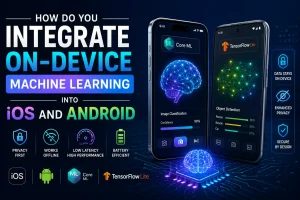
This is where Edge AI for mobile apps is changing the way intelligent applications are built. Instead of sending every request to the cloud, Edge AI allows AI models to run directly on smartphones, tablets, and other mobile devices. This means data can be processed locally, enabling faster decisions, reduced latency, and improved offline functionalities.
In this guide, we’ll explore how Edge AI works, why businesses are adopting it, how a mobile app development company can help you, its key benefits, and the future of intelligent mobile applications.
What is Edge AI for Mobile Apps?
Imagine opening a language translation app while travelling. Instead of waiting for your phone to send your voice to a cloud server and receive the translated result. Everything is done directly on your device, and it provides an almost instant response.
| Feature | Edge AI | Cloud AI |
| AI Processing | Happens directly on the mobile device | Happens on remote cloud servers |
| Response Time | Nearly instant | Depends on internet speed |
| Internet Dependency | Minimal or optional | Required for most tasks |
| Data Privacy | Data stays on the device | Data is transferred to the cloud |
| Offline Functionality | Supports offline features | Limited without internet |
| Network Usage | Lower bandwidth consumption | Higher bandwidth usage |
That is the basic idea behind Edge AI. Edge AI is the process of running artificial intelligence models directly on mobile devices rather than relying entirely on cloud servers. The “edge” refers to devices that are closest to the user, such as smartphones, tablets, wearable devices, IoT devices, or embedded systems.
Edge AI enhances user experience by bringing intelligence directly to mobile devices By 2028, over 50% of these devices are expected to be AI-capable. This allows for local data processing, resulting in faster application responses and less reliance on internet connectivity.
How Does Edge AI Work in Mobile Applications?
Although Edge AI may sound highly technical, it follows a structured process that allows AI models to operate efficiently.
Step 1: Train the AI Model
Every Edge AI application begins with an AI model. Developers first train machine learning or deep learning models using large datasets in cloud environments or high-performance computing systems. During this stage, the model learns to recognize patterns, make predictions, or perform specific tasks.
Step 2: Optimize the Model for Mobile Devices
AI models trained in the cloud are often too large to run efficiently on smartphones. Before deployment, hire mobile app developers to optimize the model by reducing its size while maintaining accuracy. Techniques such as model compression, quantization, and pruning help lower memory usage, reduce processing requirements, and improve battery efficiency.
Step 3: Deploy the Model to the Device
Once optimized, the AI model is embedded into the mobile application or downloaded securely during installation. From this point onward, the device contains its own AI engine capable of making decisions without sending every request to a cloud server. It allows applications to continue functioning even in areas with poor internet connectivity.
Step 4: Process Data Locally
Whenever a user acts like scanning a document, taking a photo, or browsing products, the system analyzes the information directly. Instead of transmitting sensitive data over the internet, processing happens locally. This significantly reduces response times while improving privacy because personal information remains on the user’s device.
For example:
- A banking app can verify a customer’s identity using facial recognition within milliseconds.
- A fitness app can analyze workout movements in real time.
- A shopping app can recommend products instantly based on browsing behavior.
- A healthcare application can monitor health metrics without relying on constant internet connectivity.
Step 5: Synchronize with the Cloud When Needed
Although Edge AI reduces cloud dependency, it does not eliminate it.
Certain tasks are still better handled in the cloud, such as:
- Retraining AI models
- Storing historical business data
- Running large-scale analytics
- Backing up information
- Deploying updated AI models
Instead of continuously transmitting every interaction, only essential information is synchronized with cloud services. This balanced approach combines the speed of local processing with the storage capabilities of cloud infrastructure.
What are the Key Benefits of Edge AI in Mobile Development ?
While faster performance often receives the most attention, Edge AI offers several business advantages that extend beyond speed.
Lower Latency for Faster User Experiences
Latency refers to the time it takes for an application to respond after receiving a request. Traditional cloud-based AI introduces network delays because information must travel between the device and remote servers. Edge AI removes much of this delay by processing information locally.
This is valuable for apps that depend on real-time interactions, including AR, mobile gaming, navigation, facial recognition, and healthcare monitoring.
Improved Data Security
Businesses handling confidential customer information must prioritize security. Since Edge AI processes much of the data directly on the mobile device, fewer sensitive details travel across public networks. This reduces potential security risks while giving organizations greater control over how customer information is handled. Although cloud security remains important, minimizing unnecessary data transfers strengthens the overall security strategy.
Lower Bandwidth Consumption
Sending large amounts of data to cloud servers can increase network costs and slow application performance. Edge AI processes much of the information locally, meaning only important insights are synchronized with cloud platforms. This reduces bandwidth usage while improving application efficiency, especially in environments with limited internet connectivity.
Highly Personalized User Experiences
Personalization has become a major factor in customer engagement.
Edge AI enables applications to analyze user behavior in real time and adjust experiences accordingly.
For example, a retail application can recommend products based on recent browsing behavior. These intelligent experiences make applications feel more responsive and relevant to individual users.
Better Battery and Resource Optimization
Modern smartphones include specialized AI processors designed to execute machine learning tasks efficiently. By using optimized AI models, an AI app development company can help you perform intelligent operations while consuming less power. Developers can further improve efficiency by compressing AI models and selecting lightweight frameworks that balance performance with battery life.
Top Business Use Cases of Edge AI for Mobile Apps
Edge AI is helping organizations deliver smarter mobile applications across multiple sectors.
Healthcare
Healthcare professionals rely on timely information to make informed decisions. Waiting for cloud-based analysis can delay treatment, especially in emergencies. Edge AI allows mobile healthcare applications to process patient data on the device, enabling faster analysis of vital signs.
Retail
Retailers compete by delivering personalized experiences that encourage customer engagement and increase sales. Edge AI enables shopping applications to recommend products, recognize customer preferences, and analyze purchasing behavior in real time without relying entirely on cloud processing.
Banking and Financial Services
Financial institutions process thousands of transactions every second. Detecting suspicious activity quickly is essential for protecting both customers and businesses. Edge AI analyzes transaction patterns locally and identifies unusual behavior almost instantly, allowing banks to respond faster to potential fraud.
Manufacturing
Manufacturing companies use mobile applications to monitor equipment performance and reduce operational downtime. Edge AI analyzes sensor data directly on industrial devices, helping businesses identify maintenance needs before equipment failures occur.
Logistics and Transportation
Delivery companies depend on accurate route planning to improve efficiency and reduce fuel costs. Our mobile maintenance & support services integrate Edge AI processes to use GPS data, traffic conditions, and delivery schedules locally. It allows drivers to receive real-time navigation updates even in areas with unstable connectivity.
Education
Educational applications are increasingly using Edge AI to deliver adaptive learning experiences. Instead of providing identical lessons to every student, AI analyzes students’ learning progress on their devices and recommends personalized exercises.
Edge AI vs. Cloud AI: Which Is Better for Mobile Apps?
Both Edge AI and Cloud AI play an important role in modern mobile application development. The right choice depends on your business goals, performance requirements, and user expectations.
| Feature | Edge AI | Cloud AI |
| AI Processing | Happens directly on the mobile device | Happens on remote cloud servers |
| Response Time | Nearly instant | Depends on internet speed |
| Internet Dependency | Minimal or optional | Required for most tasks |
| Data Privacy | Data stays on the device | Data is transferred to the cloud |
| Offline Functionality | Supports offline features | Limited without internet |
| Network Usage | Lower bandwidth consumption | Higher bandwidth usage |
While Edge AI delivers faster responses, Cloud AI provides powerful computing resources for large-scale analytics and complex model training. Rather than replacing cloud computing, Edge AI complements it by handling real-time tasks directly on the device.
For most businesses, hybrid app development services deliver the best results by combining the speed of Edge AI with cloud computing.
Technologies Powering Edge AI for Mobile Apps
Some of the most widely used technologies include:
TensorFlow Lite
TensorFlow Lite is one of the most popular frameworks for deploying lightweight machine learning models on Android and iOS devices. It is designed to deliver fast inference while minimizing memory and battery usage.
Core ML
Core ML enables developers to integrate machine learning models into Apple applications. It works seamlessly with iPhones, iPads, Apple Watches, and Macs, allowing AI features to take advantage of Apple’s Neural Engine for improved performance.
Google ML Kit
Google ML Kit provides ready-to-use APIs for image labeling, text recognition, barcode scanning, language translation, and face detection. It allows developers to quickly add AI capabilities to mobile applications without building complex models from scratch.
ONNX Runtime Mobile
ONNX Runtime supports AI models developed using multiple machine learning frameworks. It offers flexibility for businesses that want to deploy existing models across different mobile platforms.
Qualcomm AI Engine
Many Android smartphones powered by Qualcomm chipsets include dedicated AI hardware. The Qualcomm AI Engine accelerates on-device machine learning tasks while improving energy efficiency.
Apple Neural Engine
Apple devices include specialized processors designed specifically for AI workloads. These chips significantly improve the speed of facial recognition, image processing, augmented reality, and natural language processing applications.
Future Trends of Edge AI for Mobile Apps
The future of mobile AI is moving toward faster, more autonomous, and highly personalized experiences.
Several trends are shaping this evolution:
- Generative AI on mobile devices, enabling AI assistants and content generation without relying entirely on the cloud.
- 5G and Edge AI integration, delivering ultra-low latency for intelligent applications.
- TinyML, allowing AI models to run on extremely resource-constrained devices.
- Federated Learning, enabling AI models to improve while keeping user data private.
- AI-powered augmented and virtual reality, creating immersive real-time experiences.
- Smarter IoT ecosystems, where connected devices collaborate using on-device intelligence.
- Context-aware mobile assistants, capable of understanding user behavior and making proactive recommendations.
Businesses that invest in Edge AI today will be better positioned to deliver innovative digital experiences as these technologies mature.
Conclusion
Mobile users expect applications that are intelligent, responsive, secure, and available whenever they need them. Traditional cloud-based AI has enabled many innovative experiences, but growing demands for real-time performance, stronger privacy, and offline functionality are driving businesses toward a more efficient approach.
Edge AI for mobile apps brings artificial intelligence closer to the user by processing data directly on the device. This results in faster response times, reduced latency, improved security, lower cloud costs, and highly personalized experiences that enhance customer satisfaction.
Frequently Asked Questions
What is Edge AI for mobile apps?
Edge AI for mobile apps is the practice of running artificial intelligence models directly on smartphones or tablets instead of relying entirely on cloud servers. This enables faster processing, lower latency, better privacy, and offline functionality.
How does Edge AI improve mobile app performance?
Edge AI reduces the need to send data to remote servers for processing. By analyzing information directly on the device, applications respond faster and provide smoother user experiences.
Can Edge AI work without an internet connection?
Yes. Many Edge AI features continue working offline because AI models are stored and executed locally on the device. Some advanced features may still require cloud connectivity.
Which industries benefit the most from Edge AI?
Healthcare, retail, banking, manufacturing, logistics, automotive, education, travel, and smart home industries are among the biggest adopters of Edge AI for mobile applications.
Is Edge AI more secure than cloud-based AI?
Edge AI improves privacy by processing sensitive information on the device instead of continuously transmitting data to cloud servers. However, strong encryption and secure application development remain essential.
Which frameworks are commonly used for Edge AI mobile app development?
Popular frameworks include TensorFlow Lite, Core ML, Google ML Kit, ONNX Runtime Mobile, Qualcomm AI Engine, and Apple’s Neural Engine.
How much does it cost to develop an Edge AI mobile app?
The cost depends on factors such as AI model complexity, platform selection, integrations, features, testing requirements, and ongoing maintenance. A detailed project assessment provides the most accurate estimate.
Is Edge AI suitable for enterprise mobile applications?
Yes. Enterprise organizations use Edge AI to improve operational efficiency, strengthen security, enable real-time decision-making, and deliver highly personalized customer experiences across various business functions.